
Drip Line vs Drip Tape: Which One for Your Field?
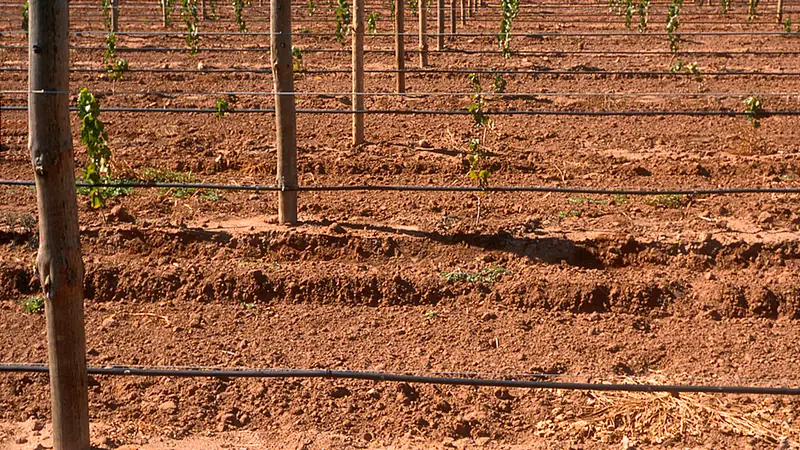
Table of Contents
What Each Product Is
Both products are polyethylene tubing with emitters built in, and both do the same job — deliver a measured trickle along a row. The difference is engineering intent:
- Drip line is a rigid, thick-walled tube (16 mm typical, wall 0.6–1.2 mm) designed to last multiple seasons. It holds its shape, survives UV, and can be moved, coiled and re-laid.
- Drip tape is a thin, flat tube (16 or 22 mm, wall 0.15–0.4 mm) that rolls flat when empty. It's cheaper per meter and designed for one season — roll it out, use it, dispose of it.
Both carry inline emitters at fixed spacing. The choice between them is a lifecycle-cost decision, not a quality decision: tape isn't "bad line," it's a different product for a different rotation.
Wall Thickness & Lifespan
| Property | Drip line | Drip tape |
|---|---|---|
| Typical diameter | 13 / 16 mm | 16 / 22 mm |
| Wall thickness | 0.6–1.2 mm | 0.15–0.4 mm |
| Lifespan | 5–10 seasons | 1–2 seasons |
| UV resistance | High (UV-stabilized) | Moderate — degrades in sun |
| Puncture resistance | Good — shrugs off tools | Weak — tears easily |
| Pressure rating | Up to ~2.5–4 bar | ~0.5–1.0 bar typical |
| Reuse | Coil, store, re-lay | Dispose after season |
The lifespan gap is the whole economics: tape costs less upfront but is a recurring cost every season, while line's higher price is paid once.
Flow & Spacing Options
Both products come in the same emitter flow families — 1–4 L/h typical for row crops — with these differences in practice:
- Drip line spacing: 20, 30, 50, 75, 100 cm with 2–8 L/h emitters. The wider spacing options suit orchards and vines; the 20–30 cm options suit vegetables.
- Drip tape spacing: usually dense — 10, 20, 30 cm at 1–3 L/h — because tape is used for close-row, high-frequency vegetable irrigation where every plant sits near an emitter.
- Wetting pattern: tape's dense emitter spacing creates a nearly continuous wet strip, ideal for shallow-rooted crops on sandy soils; line's wider spacing wets discrete bands around each emitter.
Both should be run at their rated pressure — tape especially, because thin walls can't take over-pressure. Tape systems need a pressure regulator set at 0.5–1.0 bar; line can take 1.0–1.5 bar.
Cost per Hectare
Per-meter price makes tape look like the obvious buy; per-hectare lifecycle cost tells a different story. A 1 ha vegetable block at 1 m row spacing uses about 10,000 m of lateral:
| Scenario | Lateral cost / ha | Replacement | 5-year cost |
|---|---|---|---|
| Drip tape, single-season | Lower upfront | Every season | ≈ 5 × tape cost + disposal labor |
| Drip line, multi-season | 2–3× tape upfront | Every 5–10 seasons | ≈ 1–1.5 × line cost |
On a 5-year horizon, drip line is usually the cheaper system — the break-even lands around season two to three depending on your local tape price. Tape wins the cash-flow argument for growers who can't front the line cost or who change field layouts every season.
When to Choose Which
Choose drip tape when:
- You grow short-season vegetables (lettuce, onion, carrot) with 1–2 crops per year and rotate fields annually.
- Rows are close and crops are shallow-rooted — tape's dense spacing fits.
- Cash flow favors low upfront spend and you already have the labor to lay and pick up tape.
- You use plastic mulch — tape under mulch is a proven, cheap combination.
Choose drip line when:
- Fields stay put for multiple seasons (orchards, vineyards, permanent beds, perennials).
- You want subsurface drip — line can be buried; tape collapses and clogs underground.
- Rodents and tools are a problem — thick walls resist both.
- You're importing in volume and want one order to serve several seasons with standard spares.
Sourcing Specs
When you order either product in bulk, pin down these specs in writing:
- Wall thickness and diameter — exact mm values, not "heavy duty" adjectives. A 0.2 mm tape and a 0.4 mm tape are different products.
- Emitter flow, spacing and type — e.g. 2 L/h PC inline emitters at 30 cm, ±10% tolerance, tested at 1 bar.
- Pressure rating and operating range — for tape, confirm the maximum working pressure so your regulator setting is safe.
- Roll length and packing — typical rolls run 100–400 m; 16 mm line at 100–200 m per lateral is a common field design unit. Confirm meters per roll and carton counts for your freight plan.
- UV stabilization — ask for the carbon black content or UV test result; it's the difference between a 2-season and 8-season line.
- MOQ and lead time — MOQ 1,000 pcs or by roll count, samples in 7–10 days, production 20–35 days. Test a roll on a pressure bench before committing a container.
Ordering drip line and tape is ordering a lifecycle decision, not a tube of plastic. Price per meter is the last number you should compare; cost per season is the one that matters.
NEXT STEP
Ready to Upgrade Your Irrigation?
Send us your requirements — our team responds within 24 hours with pricing and lead time.
Written by
Ray ChanIrrigation Buyer's Guide Author · Drip Irrigation Specialist. Ray helps global importers and growers source reliable irrigation products.