
Drip Emitter Guide: Flow Rates, Types & Maintenance
Table of Contents
How Emitters Work
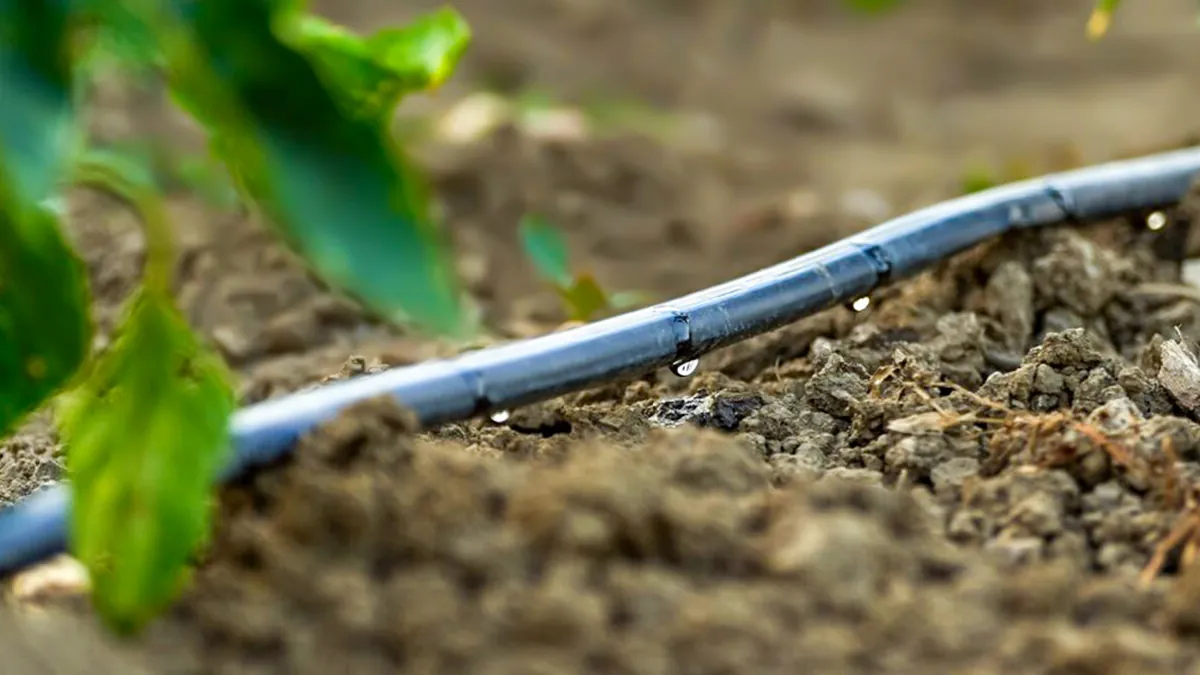
A drip emitter is a small flow-control device that turns line pressure into a slow, steady trickle — 2 to 16 L/h, against the 300–1,500 L/h that would pour out of an open pipe end. It does this by forcing water through a long, narrow labyrinth channel: the water loses pressure along the channel walls, so what exits is a drip instead of a jet.
That labyrinth is also why emitters clog — the channel is deliberately tiny. And it's why every emitter spec sheet talks about filtration: the emitter's internal channel is the smallest passage in the whole system, so it defines how clean the water must be.
Types: PC vs Non-PC, Inline vs Online
Two independent axes describe any emitter — how it's installed, and whether it compensates for pressure:
| Type | Flow | Typical use | Key trade-off |
|---|---|---|---|
| Inline (in-line) emitter | 2–4 L/h | Drip line for row crops, beds | Built into the line at the factory; spacing fixed at purchase |
| Online (on-line) emitter | 2–16 L/h | Pots, trees, custom spacing | Punched into plain tubing; spacing adjustable, more fittings to fail |
| Non-PC (turbulent flow) | 2–8 L/h | Flat ground, short runs | Cheaper; flow drops along the run and with pressure changes |
| Pressure-compensating (PC) | 2–16 L/h | Slopes, long runs, orchards, greenhouses | Constant flow across 0.5–4 bar; costs more per emitter |
Inline emitters are factory-spaced (20, 30, 50, 75, 100 cm are common), so you must decide spacing when you buy the line. Online emitters are punched in on site, which suits orchards and pots where spacing follows the plants. PC and non-PC versions exist in both formats.
Flow Rates & Spacing
Flow and spacing together determine how much water a meter of row delivers per hour — the number you build schedules from:
| Flow | Common spacing | Output per meter | Typical crop |
|---|---|---|---|
| 2 L/h | 20–30 cm | 7–10 L/h per m | Vegetables, beds, greens |
| 4 L/h | 30–50 cm | 8–13 L/h per m | Tomatoes, peppers, nursery rows |
| 8 L/h | 50–100 cm | 8–16 L/h per m | Tree rows, orchards, vines |
| 16 L/h | Per tree, 2–8 drippers | — | Mature trees, large pots |
Match emitter spacing to plant spacing, not the other way around: every plant should sit within 10 cm of an emitter. In a bed with plants 25 cm apart, a line with 30 cm spacing leaves some plants dry; drop to 20 cm spacing or add online drippers at the gaps.
Pressure Compensating Explained
PC emitters contain a flexible diaphragm that constricts as pressure rises, holding flow constant across a wide pressure window — typically 0.5 to 4 bar. A non-PC emitter at the start of a 150 m lateral might deliver 4 L/h while its twin at the far end delivers 2.8 L/h, because friction has eaten the pressure. A PC emitter delivers the rated flow at both ends.
Where PC pays for itself:
- Slopes — non-PC emitters over-water at the bottom of a hill and under-water at the top.
- Runs over 50–100 m — the longer the lateral, the wider the non-PC flow spread.
- Orchards and greenhouse benches — plant-to-plant uniformity is the whole point.
- Mixed pressures — if zones share a header at different elevations, PC keeps them equal.
The price difference is real but small per emitter; on anything but a flat 50 m bed, it's the cheapest insurance you can buy.
Clogging & Maintenance
Clogging is the #1 field failure of drip systems, and it's almost always preventable:
- Filter at 120 mesh (about 130 microns) for emitters up to 4 L/h; 80 mesh for large 8–16 L/h emitters on clean water. The filter protects the labyrinth — see the filter guide for mesh math.
- Flush laterals monthly — open end caps until water runs clear. Sediment accumulates at line ends even with good filtration.
- Flush after fertigation — fertilizer precipitates are the classic chemical clog; run clear water 5–10 minutes after every injection.
- Self-cleaning turbulent-flow emitters — the labyrinth design flushes particles during pressure cycling; choose these when water quality is marginal.
- Watch for algae — in warm, sunny systems, algae grows inside translucent line; use opaque (black) line and keep exposed sections shaded.
What to Specify When Ordering
Emitters are a commodity with a wide quality spread, and the spec sheet is where the spread shows. Put these six points in your order:
- Flow rate and tolerance — e.g. 2 L/h ±10% at 1.0 bar. Ask for the factory test method; batch consistency is what matters at scale.
- PC or non-PC, with the pressure window stated (e.g. PC: 0.5–4 bar).
- Mesh / filtration requirement — the emitter's own recommendation (usually 120 mesh).
- Material — UV-stabilized PE/PP body; confirm the emitter is compatible with the fertilizer chemistry you inject.
- Spacing — for inline emitters, the exact spacing on the roll; for online, the barb size (4 mm / 7 mm) and tubing compatibility.
- MOQ and lead time — typical terms: MOQ 1,000 pcs, samples in 7–10 days, production 20–35 days. Order samples, install them on a test bench, measure flow across the batch, then commit volume.
Emitters are the cheapest component in a drip system and the one that decides whether the system works. Buy them on tested numbers, not on brand reputation, and your field performance will follow.
NEXT STEP
Ready to Upgrade Your Irrigation?
Send us your requirements — our team responds within 24 hours with pricing and lead time.
Written by
Ray ChanIrrigation Buyer's Guide Author · Drip Irrigation Specialist. Ray helps global importers and growers source reliable irrigation products.