
Greenhouse Irrigation: Systems for Benches, Pots & Propagation
Table of Contents
Greenhouse Watering Challenges
A greenhouse changes the irrigation math in three ways. First, plants are packed at high density — benches hold hundreds of pots per zone, and every pot needs the same water. Second, there is no rain: everything the crop gets comes through your pipes. Third, water quality degrades fast — algae, mineral precipitates and fertilizer residues concentrate in the closed environment, which is why greenhouse irrigation fails more often from clogging than from anything else.
The goal of a greenhouse system is uniformity: the same milliliters to every pot, every cycle, all season. That single requirement drives every choice below.
Benches: Drip Trays & Lines
Bench systems carry water to hundreds of pots at once. Two common layouts:
- Drip lines with pot drippers: a 16 mm header runs along the bench; 4 mm spaghetti lines branch to each pot with a drip stake or dripper at 2–4 L/h. Best for large pots and crops with different water needs per pot.
- Capillary / tray mats with drip feed: a water-absorbent mat on the bench, fed by drip line laid along the mat edge; pots wick water from below. Excellent uniformity for small pots and plug flats, and it keeps foliage dry.
- Micro jets on frames: for bench crops that tolerate leaf wetting (some leafy greens), micro jets at 20–70 L/h mounted overhead cover a bench in one line.
Whatever the layout, the critical spec is pressure-compensating emitters. A bench run of 15–25 m with non-PC emitters shows visibly less water at the far end; pressure-compensating 2 L/h drippers hold flow within tolerance across the whole bench.
Pots & Container Irrigation
Container crops — nursery stock, ornamentals, potted vegetables — sit in a growing medium that drains fast and holds little water, so they need frequent, precisely metered irrigation:
- Drip stakes: a stake with a 2–8 L/h emitter pushed into each pot. Flow matches pot size: 2 L/h for 10–15 cm pots, 4 L/h for 20–25 cm, 8 L/h for large nursery containers.
- Ring or spiral drippers: for large containers, a ring emitter at the pot rim delivers a circle of water around the trunk instead of one wet point.
- Run times: pot crops typically cycle 2–4 times daily in peak season, short cycles of 5–15 minutes, because the medium drains quickly and frequent small doses keep the root ball uniformly moist.
When pots are on gravel or weed-mat floors, consider drip tape under the pots — the tape wets the whole floor zone and roots that escape the pot bottom still find water. Tape here is a consumable; replace it with the crop cycle.
Propagation & Mist
Cuttings and seedlings have no root system yet — they need leaf wetting, not soil watering. That's a misting job:
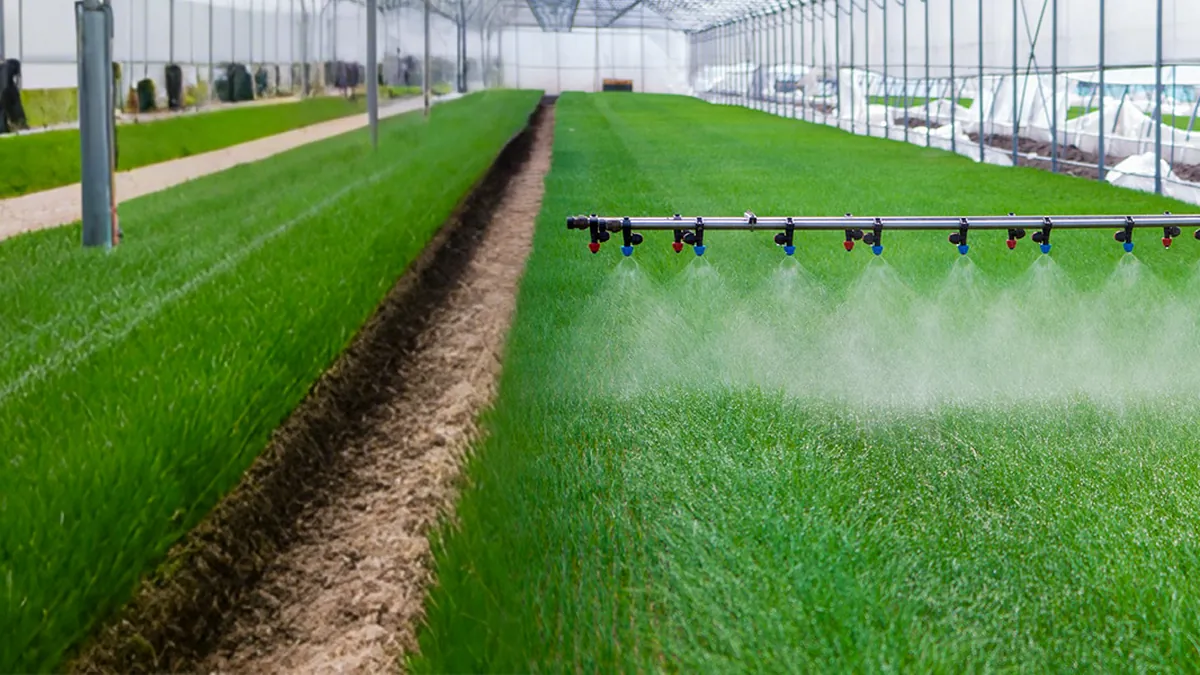
- Mist nozzles at 20–60 L/h, 1.5–3.0 bar, spaced to overlap the propagation bench, run on short bursts (5–15 seconds every few minutes) controlled by a timer or a leaf-wetness sensor.
- Under-bench heating + mist is the standard combination for rooting cuttings; the mist keeps leaves cool and turgid while the medium warms.
- Fog systems for high-humidity propagation use fogger nozzles that atomize to near-invisible droplets — finer than mist, for humidity-sensitive species.
Mist lines need the cleanest water in the greenhouse: a 120-mesh or finer disc filter is the minimum, and a water softener may be needed where supply is hard, because scale blocks mist nozzles within weeks.
Filtration & Fertigation
Two pieces of infrastructure make or break a greenhouse system:
- Filtration. Greenhouse water carries algae, organic slime and fertilizer precipitates. Disc filters beat screen filters here because you can flush them in place without opening the housing. Size the filter for the peak zone flow, and add a second stage (e.g. 80 mesh then 120 mesh) where the source is a pond or storage tank. Algae growth inside lines is controlled by keeping lines full and dark, and by flushing with clean water regularly.
- Fertigation. Dosing fertilizer through the irrigation system is standard in commercial greenhouses — constant-dilution injectors (e.g. 1:100) or proportional dosing pumps. Injection must be followed by a clear-water flush of 5–10 minutes per cycle to keep emitters free of precipitate. Use fertigation-safe components: no brass or galvanized parts in contact with the solution, since fertilizer salts corrode them.
Automation Options
Greenhouse labor is expensive and watering is repetitive — automation pays back fast:
- Zone timers: each bench group on its own valve and schedule. Minimum viable automation; handles off-hours irrigation.
- Irrigation controllers with EC/pH monitoring: dose cycles by accumulated light (a "light sum" timer that irrigates more on sunny days) or soil moisture sensors in representative pots.
- Climate-linked control: mist and fog tied to temperature and humidity sensors, so propagation misting responds to actual leaf conditions.
- Drainage monitoring: catch and measure runoff from representative pots; when runoff volume drifts, emitters are clogging or the schedule is off.
For a new greenhouse project, spec the system in this order: filtration station, fertigation, zone valves, then emitters — because the emitter choice is meaningless if the water quality and pressure aren't right upstream. Send your bench dimensions, pot counts and water source to your supplier and the layout can be sized from those three numbers.
NEXT STEP
Ready to Upgrade Your Irrigation?
Send us your requirements — our team responds within 24 hours with pricing and lead time.
Written by
Ray ChanIrrigation Buyer's Guide Author · Drip Irrigation Specialist. Ray helps global importers and growers source reliable irrigation products.