
Micro Sprinkler vs Drip Irrigation: Which System Fits Your Crop?
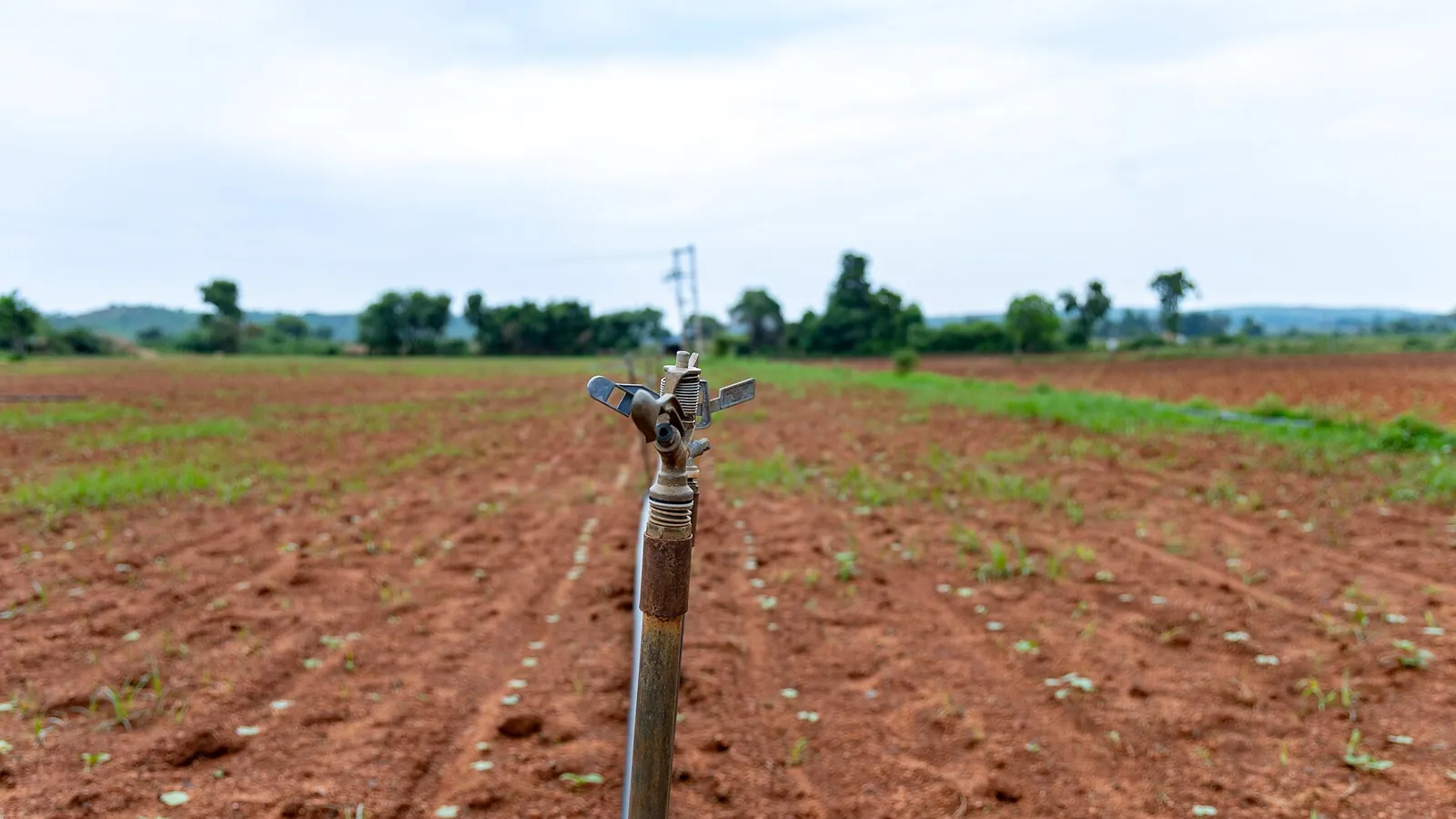
Table of Contents
How Each System Delivers Water
The two systems are cousins — same low-pressure plumbing, same filters, same pumps — but they apply water in fundamentally different shapes. Drip delivers water to a point: 2–16 L/h emitters wet a narrow strip of soil along the row. Micro sprinklers deliver water to an area: heads throwing 20–300 L/h wet a circle 1.5–8 m across.
That one difference drives everything else — spacing, scheduling, crop fit and cost. Drip is a precision tool; micro sprinklers are a coverage tool. Neither is better; each fits a different root system and climate.
Coverage & Wetting Pattern
Drip wets a band roughly 20–40 cm wide per lateral. In row crops the roots grow into that band and stay there, which is efficient — and fragile: if the band is mis-positioned or an emitter fails, that plant loses its water supply. Micro sprinklers wet the full circle between plants, so the whole root zone sees water and a single blocked head is less damaging because neighbors' wetting circles overlap.
| Factor | Drip | Micro sprinkler |
|---|---|---|
| Wetted area | Narrow strip (20–40 cm) | Circle 1.5–8 m diameter |
| Emitter/head flow | 2–16 L/h | 20–300 L/h |
| Operating pressure | 0.8–2.0 bar | 1.5–4.0 bar |
| Wets foliage? | No (below-canopy) | Often yes, depending on head placement |
| Filtration need | 120 mesh typical | 80–120 mesh |
Water Use & Efficiency
Both systems beat conventional sprinklers by a wide margin — field trials and irrigation practice consistently put savings at 50–70% versus sprinkler or flood irrigation — but drip is the more water-stingy of the two:
- Drip loses less to evaporation and wind. Water goes straight into the root zone; nothing is sprayed into the air. On windy sites, drip's advantage grows because spray drift is zero.
- Micro sprinklers wet more surface area, so more water evaporates from soil and foliage, and some is lost to wind on open fields. They still save 40–60% versus conventional sprinklers because flows are low and application is localized.
- Drip enables precise scheduling — short, frequent cycles matched to daily crop water use. Micro sprinklers apply more water per minute, so cycles are longer and less precise.
If your constraint is water — limited allocation, high pump energy, sandy soil — drip wins. If your constraint is root coverage or canopy cooling, micro sprinklers win.
Crop Suitability
Match the system to how the crop's roots behave and whether the canopy tolerates wetting:
- Row vegetables (tomato, pepper, onion, lettuce) — drip. Roots stay shallow and concentrated; drip keeps foliage dry, which suppresses fungal disease, and fertigation puts nutrients exactly at the roots.
- Tree crops (citrus, avocado, apple, olive) — both work. Young trees with small root zones take 2–4 drippers each; mature trees with wide canopies are often better served by micro sprinklers that wet the whole feeder-root zone. Many orchards run drip for young trees and convert to micro sprinklers at maturity.
- Nursery and propagation — micro misters for cuttings (they need leaf wetting), drip stakes for pot lines.
- Wide-spaced field crops — micro sprinklers cover between-row ground that drip leaves dry, which matters for soil cooling and cover crops.
Cost Comparison
Per hectare, drip usually carries the higher upfront cost because every row needs a lateral line with emitters. Micro sprinklers need fewer emission points — heads are spaced meters apart — so hardware per hectare is typically lower, though each head costs more than one dripper.
| Cost item | Drip | Micro sprinkler |
|---|---|---|
| Emission points per ha | 15,000–40,000 emitters | 300–2,500 heads |
| Lateral pipe per ha | High (every row) | Lower (head spacing) |
| Filtration station | 120 mesh, same for both | 80–120 mesh |
| Install labor | Higher (punching, laying) | Lower |
| Operating pressure | Lower (less pump energy) | Higher (more pump energy) |
| Replacement cost | Emitters cheap, many of them | Heads pricier, fewer of them |
For importers the practical difference is in the container: a drip kit for 1 ha packs far more line and emitters, while a micro sprinkler kit packs more heads and stands. Freight and MOQ planning should start from that difference.
Hybrid Systems
The best answer is often both. Common hybrid layouts:
- Drip in the row, micro sprinklers between rows — for high-value vegetables that also need canopy cooling in hot climates.
- Drip for young trees, micro sprinklers for mature blocks — one filter station, two application zones, valves switching between them.
- Micro mist for propagation, drip stakes for finished pots — standard in commercial nurseries.
Because both systems share headers, filters and regulators, building a hybrid zone costs little extra at design time. Specify your crop list, row spacing and water source to your supplier, and ask for a layout that covers the young-tree phase and the mature phase with the same station.
NEXT STEP
Ready to Upgrade Your Irrigation?
Send us your requirements — our team responds within 24 hours with pricing and lead time.
Written by
Ray ChanIrrigation Buyer's Guide Author · Drip Irrigation Specialist. Ray helps global importers and growers source reliable irrigation products.